Three kinds of work.
One starting point.
Before deciding how to restore a pane, establish what is affecting it. A deposit resting on glass, a scratch in the surface and cloudiness within a laminate are different problems. Applying the same treatment to all three is unlikely to answer the right question.
- Glass polishing
- Surface refinement where the glass, finish and condition are suitable. Polishing is a method, not a promise that every visible defect will disappear.
- Scratch correction
- Work directed at assessed surface scratches, including suitable wiper marks. The appropriate method depends on the damage and the optical result that can reasonably be achieved.
- Surface-stain restoration
- Work on persistent surface marks after distinguishing deposits from damage to the glass or a coating. Suitable cleaning may resolve a concern without abrasive correction.
Helm Glass’s service is for actual glass. Acrylic, polycarbonate and coated flexible panels require their own material-specific advice.
Establish a useful baseline.
A good assessment records more than the worst-looking mark. It identifies the pane, the affected side, the material and any known treatment. It also considers where you normally look through the glass and which defects you most want to improve.
Identify the surface.
Check the glazing specification, maker’s markings and any coating or film information. If the identity is uncertain, resolve it before choosing a correction method.
Separate the concerns.
Record scratches, deposits, haze and edge or frame issues separately. One pane can have more than one condition, and only some may be within a restoration scope.
Agree a representative test.
Where suitable, choose an area that represents the proposed work. State what the test needs to establish, what improvement would be worthwhile and what would rule out proceeding.
Review before expanding.
Inspect the result from ordinary viewing positions. An improvement in a close-up photograph should not be the only basis for authorizing the whole pane.
What changes after correction
The mark and the view
both deserve attention.
Some correction methods remove surface material. GlasWeld identifies optical distortion as a possible effect of its more aggressive abrasive process; Mirka also cautions about optical refraction during glass restoration. The method and the result need to be considered together.
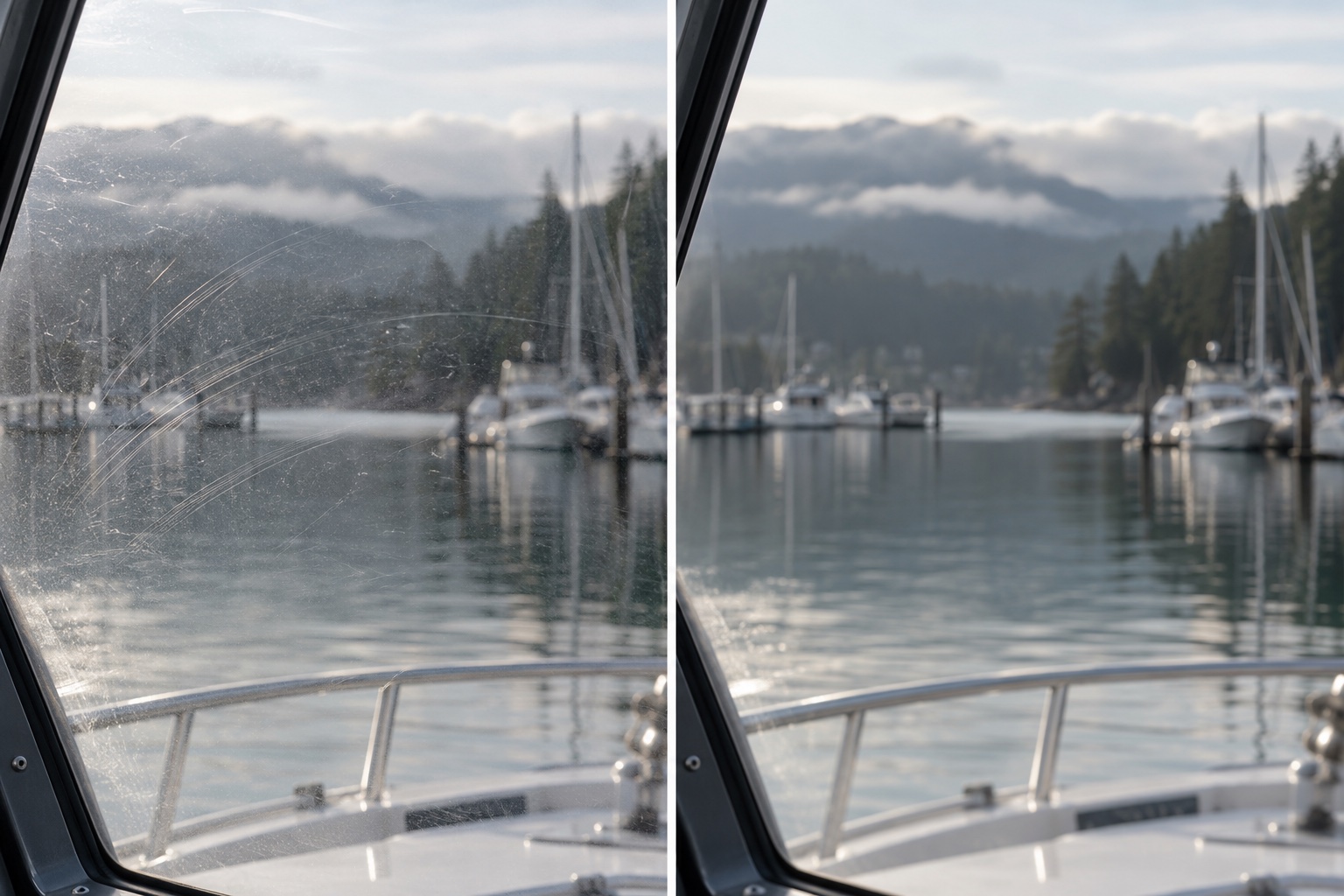
Agree how the test and final finish will be reviewed. Look through the pane from its normal position as well as looking at the surface. Include the helm sightline where relevant, rather than relying on reflections or a single flattering angle.
Ask which marks may remain, how the transition around a corrected area will be assessed and whether the demonstrated improvement justifies the proposed scope.
A clean pane should not require a closing argument. Agree what a satisfactory result means before the work begins.
A defined scope
protects the whole project.
For the avoidance of doubt, Helm Glass offers surface restoration. We do not offer glass replacement, installation, leak repair, frame repair or structural glazing repair.
Exterior polishing cannot reach a defect between panes or inside laminated glass. Cracks, edge damage, movement and concerns about the glazing assembly require an appropriately qualified marine glazing specialist.
Coatings, films, texture and heating elements also need to be identified. Never assume that a method suitable for an untreated pane is suitable for another surface.
Restoration suitability is a specific decision. It depends on the individual pane, the proposed method and the result required. It is not established by the vessel’s age, a photograph or the general description “marine glass.”
Decide what is worth doing.
A single helm windscreen, a few cabin windows and a vessel-wide pane list are different briefs. Identify the glass that matters most to the way the boat is used. The priority may be the view from the helm, a frequently used seating position or persistent staining across several exposed panes.
For an owner, captain or yacht manager, a useful proposal separates the assessment or test from the larger scope. Agree which panes are included, who can authorize further work and what happens if the test does not support proceeding. Keep any unresolved coating, access or assembly issue visible in the brief.
We consider projects in Greater Vancouver and selected travel work across Canada. Location, the number and size of affected panes, access and the vessel’s available working period help establish whether a visit makes sense. Exact arrangements and pricing follow the job’s assessed scope.
Does every scratch need to be fully removed?
No. Decide what outcome matters before choosing the scope. An agreed improvement may be useful even where complete removal is unsuitable. The assessment and test should make that tradeoff clear.
Can you quote from photographs?
Photographs are useful for the first conversation. They cannot reliably establish scratch depth, material identity or the optical outcome of correction. Further information or an inspection may be needed before scope and price can be agreed.
Is restoration always preferable to replacement?
No. Compare the actual condition, expected result, access and scope. Restoration concerns a suitable existing surface; it cannot solve every problem with a pane or glazing assembly. Helm Glass does not provide replacement quotes or installation.
Can this be included in a refit?
Yes, it can be discussed as part of the planning. Identify the glazing concerns early, record the existing condition and coordinate the proposed work with the person responsible for the yard period. Timing and suitability must be confirmed for the job.